

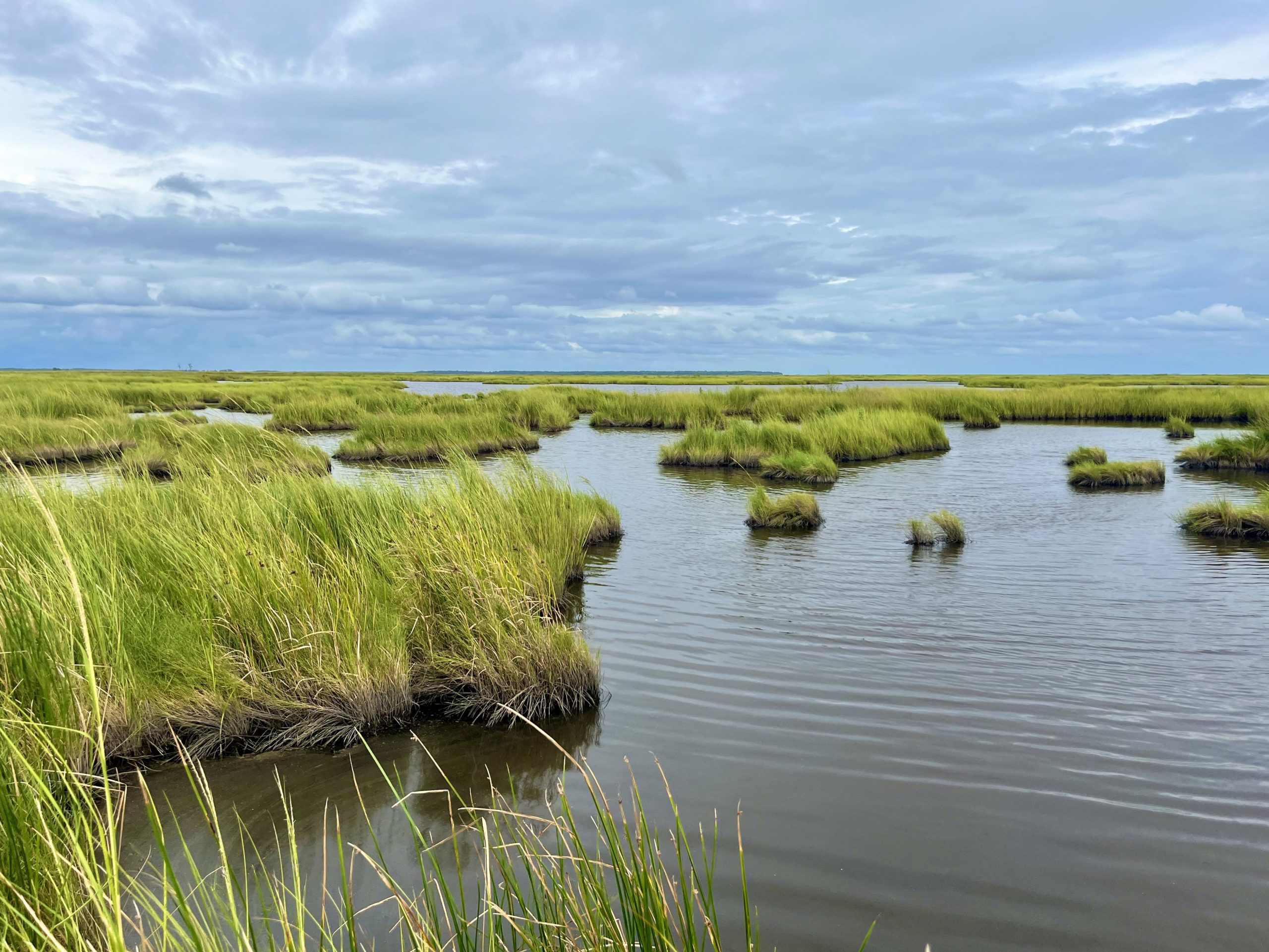
A low marsh in Dorchester County. DNR photo
Roots for Resilience, a Maryland Department of Natural Resources initiative to support climate adaptation on the Eastern Shore, has approved seven grants totaling more than $4.5 million to protect large areas of healthy saltmarsh habitat.
These living shoreline projects will protect coastal areas and islands from shoreline erosion, providing a buffer for local communities and securing habitat for migratory birds like the saltmarsh sparrow and other sensitive wildlife species. The awarded projects include work that will specifically protect an important roadway and an outdoor space to support veterans.
The construction of these living shorelines will contribute to the Roots for Resilience goal of protecting 400 acres of high-quality marsh habitat by 2029.
A living shoreline uses nature-based erosion control techniques, such as marsh plantings, coir logs, sills, and breakwaters, to stabilize shorelines while maintaining natural coastal processes to ensure future resilience. These approaches reduce erosion and flooding, protect infrastructure, lower long-term costs, support working waterfronts, and strengthen coastal adaptation to sea level rise.
“These projects are ideally suited for the Roots for Resilience initiative, designed for the vulnerable communities of the Eastern Shore,” DNR Secretary Josh Kurtz said. “The shared goals of protecting people and habitats are vitally connected. These living shoreline projects demonstrate how solutions work best when we work with nature to benefit local communities.”
DNR’s Roots for Resilience, which recently launched in May 2026, is supported by $42.5 million in federal grant funding, allowing the department to invest in nature-based climate solutions like tree plantings, sustainable forest management, coastal wetland restoration, and living shoreline projects.
These efforts are funded through a Climate Pollution Reduction Grant from the U.S. Environmental Protection Agency, awarded to the Atlantic Conservation Coalition, made up of The Nature Conservancy and agencies in four coastal states, including DNR and the Maryland Department of the Environment.
Saltmarshes on the Eastern Shore are at risk from sea-level rise and gradual sinking, making these low‑lying coastal marshes at high risk of drowning or converting to open water. These critical habitats provide many benefits, acting as natural buffers that filter pollutants, sequestering carbon in plant roots and soil, and stabilizing shorelines from erosion and storm surges.
The grant recipients include Maryland counties and nonprofit organizations, selected through a Request for Proposals process. One project is ready for construction, and the initiative will fund the design for six other projects that will be eligible for construction funding. The total funding available through this program for living shoreline restoration projects is approximately $17 million.
Roots for Resilience living shoreline projects will take place across Dorchester and Somerset counties from 2026 to 2029. Projects will leverage additional funds and in-kind service committed by project partners.
Project locations for the living shoreline grants include:
- Wroten Island – A grant to Green Trust Alliance supports a shovel-ready, permitted living shoreline project located at Wroten Island to reduce erosion while protecting over 150 acres of marsh habitat. Construction is expected to begin in fall 2026.
- Pocomoke Sound – A grant to the Lower Shore Land Trust will support the design of a living shoreline on property under conservation easement located along the shoreline of the Pocomoke Sound to protect over 200 acres of healthy salt marsh habitat for sensitive species like the eastern diamondback terrapin and saltmarsh sparrow.
- Smith Island – A grant to Ducks Unlimited will increase resilience on Smith Island within the Martin National Wildlife Refuge by designing a living shoreline that protects 118 acres of marsh habitat that is critical for migrating waterfowl.
- Deal Island – A grant to the Alliance for the Chesapeake Bay will support the design of a living shoreline within the Deal Island Wildlife Management Area at Little Deal Island to protect 78 acres of marsh by preventing excess shoreline erosion along the southwestern side of the island.
- Franks Island – A grant to Somerset County supports the design of a living shoreline to protect 72 acres of marsh against erosion to bolster capacity of Franks Island to withstand storm impacts, and protect the Deal Island Causeway.
- Fishing Bay – A grant to Dorchester County will support the design of a living shoreline to mitigate excess erosion and protect 116 acres of marsh at Fishing Bay Wildlife Management Area, which includes habitat for a variety of birds and aquatic species.
- Taylors Island – A grant to the Military Bowl Foundation for the design of a living shoreline, located at an outdoor retreat for veterans at Patriot Point. The project aims to protect 100 acres of marsh habitat along migratory routes for birds and other wildlife.
Under the Roots for Resilience initiative, DNR is also currently reviewing applications for nonprofits that will engage with county governments and conduct outreach to communities for enhanced forestry management, as well as finding and paying contractors to help reach the forest management goal for Roots for Resilience. Additional opportunities will be listed on the Roots for Resilience open solicitations website.
This project has been funded wholly or in part by the United States Environmental Protection Agency under assistance agreement 3D25824 to the North Carolina Department of Natural and Cultural Resources. The contents of this document do not necessarily reflect the views and policies of the Environmental Protection Agency, nor does the Environmental Protection Agency endorse trade names or recommend the use of commercial products mentioned in this document, as well as any images, video, text, or other content created by generative artificial intelligence tools, nor does any such content necessarily reflect the views and policies of the Environmental Protection Agency.
